In the Horizon project EMPHASIS (https://www.emphasis-supercaps.eu/), new materials and technologies for sustainable energy storage in next-generation super-capacitors were developed. Wood K plus played a key role in both material development and sustainability assessment.
Since January 2023, Wood K plus has been conducting joint research with 13 other partners from six countries in the Horizon project EMPHASIS. The project’s innovative approach focused on developing novel materials derived from natural resources, improving design processes and advancing design architectures for energy storage solutions beyond the technical status quo. EMPHASIS proposes the development of a rational design approach that encompasses simultaneous optimisation of the most important key components of a supercapacitor (SC) cell, i.e., electrode materials, electrolytes and current collectors. The approach entails not simply a separate optimisation of these single components but also their best matching procedure, exploiting the synergy of the best performance of each component. In addition, the innovative design of SC cell architecture and control of power management are vital pillars of EMPHASIS to achieve breakthrough solutions to key applications in two areas with broad markets, i.e. smart clothing and electromobility.
In the field of materials development, Wood K plus was responsible for developing highly porous carbon fibers for electrodes. To this end, modified cellulose fibers spun by project partner CANOE were thermally treated to produce carbon fibers with the highest possible porosity. Thanks to CANOE’s special spinning process (using H3PO4 as a solvent), the cellulose fibers do not need to be additionally impregnated before thermal conversion. In contrast to commercial cellulose fibers, high yields and high porosities can therefore be achieved without additional pretreatment. In addition, additives could be introduced during the spinning process. For example, by spinning in carbon nanotubes, activated carbon fibers with increased conductivity could be produced. Through comprehensive material and process development, activated carbon fibers with surface areas of up to 3000 m²/g were produced, significantly surpassing commercial activated carbons currently used in supercapacitors.
The technological developments were supported by a comprehensive sustainability assessment. Wood K plus was leading the work package covering environmental, social, and economic aspects through Life Cycle Assessment (LCA), Social Life Cycle Assessment (SLCA), and Life Cycle Costing (LCC). The LCA identified the electrode, electricity and electrolyte as the main contributors to the environmental impact on lab-scale. In electrode production, upscaling anticipated a shift in hotspots from energy use to additives and solvents. However, increased energy efficiency remains a key factor. Combining LCA and LCC revealed trade-offs between environmental and economic sustainability. For example, improving energy efficiency strongly reduced the environmental impact, but it had limited influence on costs, which are mostly determined by labor and material costs, with the main contributor being the electrolyte. However, the latest developments in the project enable a recovery of 83 % of the electrolyte from spent cells offering huge potential for reduction of costs and environmental impact.
Based on the results, two formulations, one with commercial cellulose fibers and one with cellulose fibers from the project, were selected to produce larger quantities for the construction of demonstrators. Wood K plus produced 250 g of highly porous activated carbon fibers from the commercial cellulose reference and 70 g from cellulose fibers from the project partner CANOE.
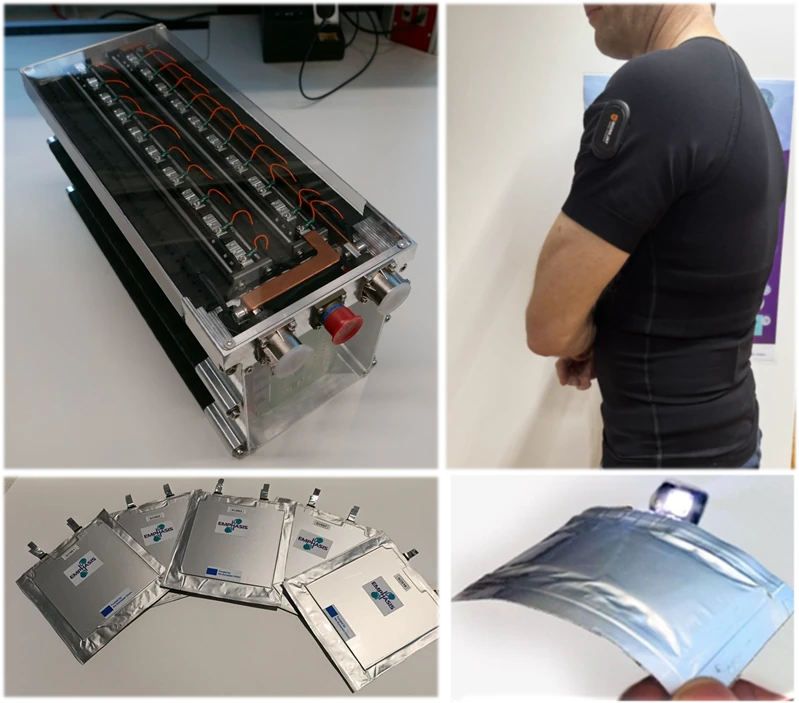
The consortium leader, Pleione Energy, used these to produce two different designs of pouch cells, which contained not only activated carbon fiber electrodes but also newly developed carbon-based current collectors and sustainable electrolytes. Several pouch cells were installed in a stack for the electromobility application of the partner CRF/Stellantis, while a flexible pouch cell was used for the functional clothing of BORN.
The project concluded by the end of 2025. The review meeting took place in Brussels on December 10th, 2025 and we have received very positive feedback from both the project officer from the European Commission as well as the scientific reviewer. Further updates will be published on the project’s LinkedIn channel even after the end of the project: https://www.linkedin.com/showcase/emphasis-supercaps/