Innovative enzyme technology for reducing dye usage in the textile industry
Economic, ecological, and regulatory conditions require the continuous development of resource-efficient textile processes. In particular, the dyeing process is associated with a high consumption of chemicals, water, and energy. The targeted functionalisation of cellulose fibers offers great potential to increase dyeing efficiency and product quality while simultaneously reducing environmental impact.
Lyocell is a biodegradable cellulose fiber made from wood, with excellent mechanical properties. However, the high crystallinity of the cellulose chains means that only few binding sites are available for charged dyes. In industrial practice, this requires high amounts of dye, resulting in increased resource consumption and wastewater load.
For this reason, the project aimed to enzymatically and selectively modify Lyocell fibers to create additional chemical binding sites for cationic dyes. This approach was intended to enable more intense and uniform coloration with reduced dye usage, without compromising fiber quality or existing industrial processes.
Functionalisation of Lyocell Fibers
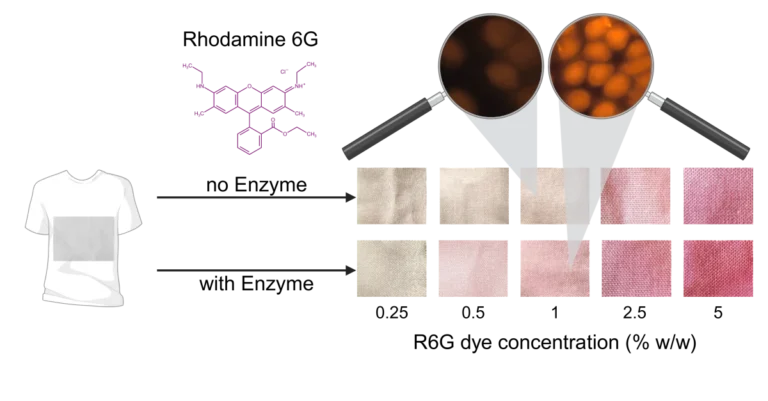
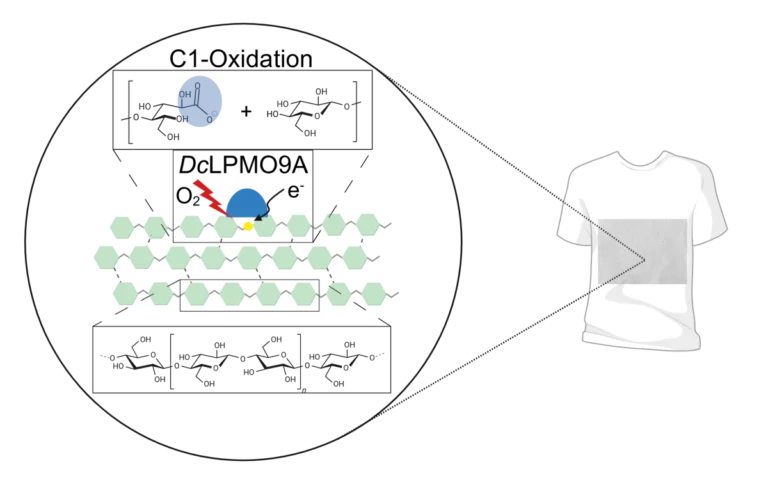
The focus of the project was the use of a lytic polysaccharide monooxygenase (LPMO), which selectively oxidizes cellulose at the C1 position and generates additional carboxyl groups on the fiber surface. This surface-near modification occurs without significant degradation of the cellulose chains and specifically increases the fibers charge, thereby enhancing its affinity for cationic dyes without affecting its mechanical properties. Even small enzyme loadings significantly increase the density of carboxyl groups while causing negligible mass loss. At the same time, the strength and structural integrity of the fibers remain unchanged. This work demonstrated, for the first time, a targeted enzymatic surface functionalisation of highly crystalline Lyocell cellulose without compromising fiber functionality. The amount of dye required could be reduced by 50 % compared to untreated fibers.
In summary, the LPMO-based approach shows that enzymatic functionalisation of Lyocell fibers enables more resource-efficient dyeing processes without altering existing industrial procedures. This strengthens sustainable, bio-based textile value chains and opens new perspectives for advanced functional applications of cellulose materials.