Biodegradable Tree Guards.
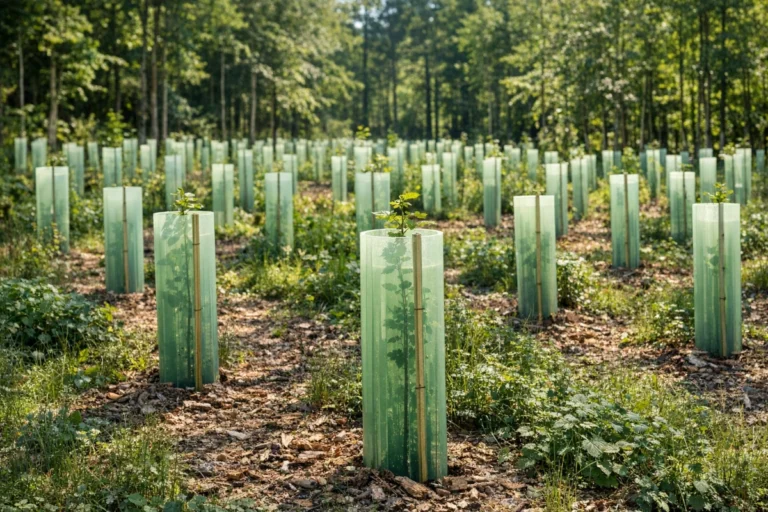
The use of renewable raw materials is a key component of a sustainable future. It enables the development of innovative products that combine ecological and economic benefits, strengthen regional value creation, and make an important contribution to the circular economy. High‑quality, efficient applications are essential to fully utilise the potential of these resources. One example is the development of a biodegradable tree guard, which demonstrates how ecological challenges can be addressed through innovative material solutions. This implementation was supported within the innovation and idea process at Wood K plus, which employs a structured stage‑gate model encouraging employees to submit new ideas, which are then evaluated by a review panel. A submission from 2021, the “biodegradable tree guards”, evolved into an impressive success story. Most tree guards currently in use are made from non-biodegradable petroleum‑based plastics which must either be laboriously removed from the forest after several years or remain persistent as microplastics. The project addresses a central ecological challenge by developing a novel, fully biodegradable protective solution. The research work included material selection, design, and life‑cycle analysis to create a guard that decomposes after a few years and additionally acts as a fertiliser. This resulted in a tree protection system that aligns circular economy principles with forestry needs. The innovation lies in the combination of ecological functionality, mechanical stability, and biological reintegration.
The development path
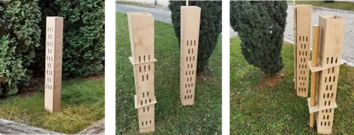
The development process began with a Master’s thesis that explored fundamental questions regarding the realisation of a degradable tree guard and produced an initial prototype. The starting material was a 2 mm thick hardboard made of 99 % wood fibers, manufactured using a wet process without additional binders. The main challenges concerned the design: the guard needed to provide optimal growth conditions, ensure an improved microclimate, and remain easy to handle. This was achieved through a special punching technique and a stitching process, allowing the product to be delivered in a space‑saving form with all necessary elements already integrated. The scientific work was recognised at the BOKU Sustainability Day 2023.
Investment and Market Potential
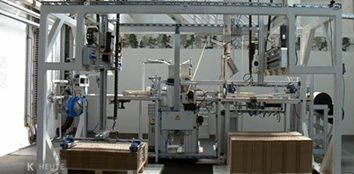
The findings from the Master’s thesis served as a scientifically sound basis for a product development process carried out in a follow‑up project by the two cooperation partners Fundermax (manufacturer of the tree guards) and Witasek (marketer of the tree guards). Following successful small‑batch production, investments were made in a sewing machine and a punching tool for industrial‑scale manufacturing to tap into the considerable market potential. With this investment, the official market launch took place in autumn 2024. The ecological savings potential is significant: in the case of an oak reforestation project, around 1.1 tonnes of polypropylene waste can be avoided per hectare. At the same time, approximately 2.5 tonnes of biomass from the decomposing guards remain in the forest, including valuable nutrients that improve soil quality. This solution therefore combines climate protection, resource conservation, and practical benefits for forestry