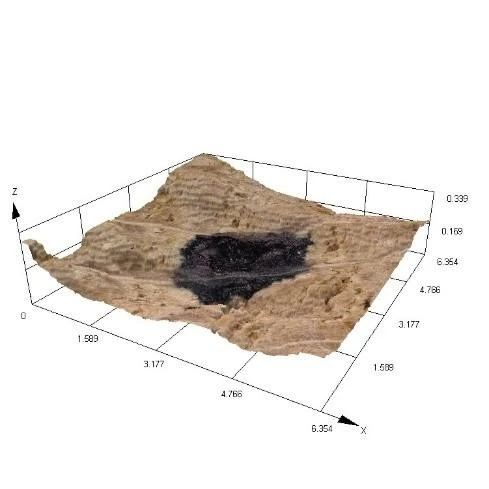
In the course of our ongoing research project trace-wood, we are looking into fundamental insights about labelling techniques for wood to ensure end-to-end tracing along its value chain. We are happy to present the first results, recently published in the journal of Wood Material Science and Engineering, which demonstrate the high potential and robustness of this labelling technique.
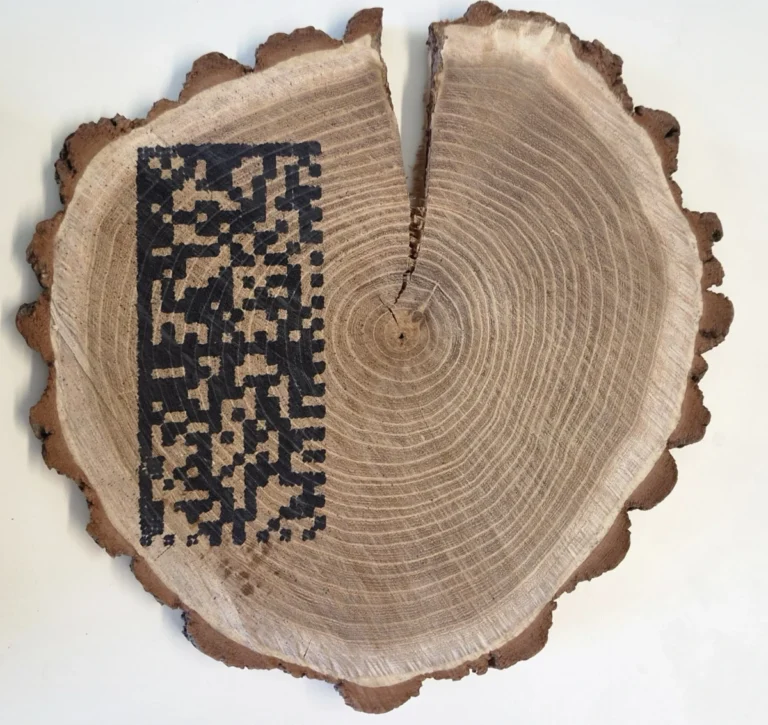
From labels to digital wood identity:
Reliable traceability is becoming a key requirement for sustainable wood value chains. New European regulations, including the EU Deforestation Regulation (EUDR), underline the need for transparent documentation of wood origin and product movement. The trace-wood project addresses this challenge by developing technologies for seamless, tamper-proof, and unambiguous identification of wood – from the tree to the final product. Within this project, the team Digital Technologies & Sustainable Building at the research Area Wood Materials Technologies in Tulln is investigating printed, ink-based codes applied directly to uncoated wood surfaces. This approach could link digital information directly to the material itself, without additional labels or external tags.
First scientific milestone:
A first scientific milestone has now been reached: the publication “Effects of Hardwood Properties and Surface Topography on the Morphology of Inkjet-Printed Dots” has been accepted in the journal Wood Material Science & Engineering. The study focuses on the smallest but essential unit of a printed matrix code: the inkjet-printed dot. In drop-on-demand digital printing, each code is built from many individual dots. Their size and shape are crucial for reliable code readability. So far, research and quality evaluation of printed two-dimensional codes have mainly focused on conventional substrates such as paper, labels, or industrial surfaces. Wood, however, is natural, porous, anisotropic, and highly variable. This study therefore systematically investigates printing quality directly on uncoated hardwood species.
Basis for robust traceability:
The novelty of the work lies in linking inkjet dot morphology with uncoated solid wood properties and surface topography. Five hardwood species, different cutting methods, and two moisture levels were studied. The results show that wood anatomy strongly affects ink spreading: printed dots tended to elongate along the radial direction, indicating the influence of wood rays. Surface roughness also affected dot formation, while moisture mainly influenced ink accumulation in surface valleys. Diffuse-porous species such as alder, cherry, and maple produced smaller and more regular dots, while oak and walnut showed stronger spreading and more deformed dots. This means that printing parameters cannot be defined independently of the wood species. Instead, they must be adapted to the anatomical structure and surface condition of the material to ensure stable dot formation and reliable code readability. This accepted publication is the first achievement in an ongoing research path. Future publications will focus on the durability of printed codes, the applicability across the entire value chain and on the readability of codes under various realistic conditions.
Further information:
Moradivandkolehjouei, S., Pinkl, S., Gindl-Altmutter, W., Riegler, M. (2026) Effects of Hardwood Properties and Surface Topography on the Morphology of Inkjet-Printed Dots. Wood Material Science and Engineering, https://doi.org/10.1080/17480272.2026.2680592