The construction industry is undergoing a profound transformation as the demand for resource-efficient, low-carbon materials continues to rise. Within this context, the Horizon Europe project ATRIUM aims to accelerate the shift toward renewable and recyclable construction products. By identifying and scaling six bio-based material systems, the project seeks to lower the sector’s heavy reliance on raw materials while reducing the carbon footprint of buildings through cascade biomass utilisation and the substitution of fossil-derived polymers.
As leader of Work Package 1, Wood K plus plays a central role in this effort by developing three innovative bio-based product systems: wood–plastic composite (WPC) terrace decking, bio-composite flooring carrier boards, and natural fiber composites (NFCs) for green infrastructure. Each development demonstrates how renewable feedstocks, industrial side streams and advanced material technologies can work together to create durable, functional and ecologically responsible solutions for the built environment.
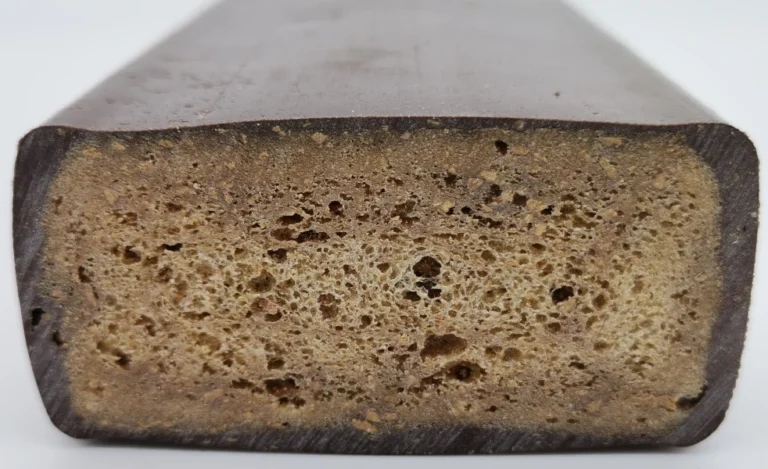
A first major focus lies on next-generation terrace decking based on bio-polyethylene from sugar cane and recycled wood dust sourced from the furniture industry. In close collaboration with the Polish outdoor-systems manufacturer Hartika, Wood K plus is combining co-extrusion technology with chemical foaming to produce lightweight yet robust profiles. Co-extruded structures featuring a foamed inner core and a denser outer layer allow for reductions in material consumption and overall weight, while offering improved resistance to insects and enhanced sustainability. After four developmental trial series, the project team has already manufactured profiles with substantially lower densities than conventional WPC decking (> 24% under the target value). The foamed core formulation consists of 78 % bio-LDPE and 20 % PB/MDF dust, activated by an endothermic chemical blowing agent, and strengthened by 2 % of a highly bio-based MAH-grafted coupling agent. The skin layer uses bio-HDPE filled with PB/MDF dust, demonstrating that high-performance outdoor materials can be produced from largely renewable inputs.
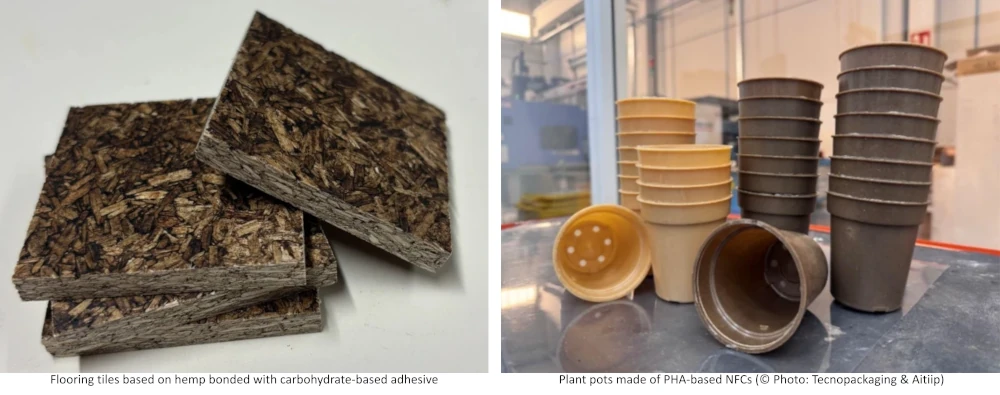
In parallel, Wood K plus is advancing bio-based flooring tiles through the development of an HMF-based binder system. Together with international partners including SQIM, the Advanced Bonding team has formulated a carbohydrate-derived adhesive created from fructose-based hydroxymethylfurfural and bis(hexamethylene)triamine. When combined with agricultural residues (with and without mycelium), this binder enables the production of composite boards with good mechanical properties. Several mixtures, including hemp shives, cotton and other alternative annual fibers such as miscanthus – are being assessed with the goal of reducing thickness swelling while maintaining strength performance for interior flooring applications. Recent test series have improved the manufacturing process and reduced thickness swelling by more than 30 %, although further optimisation is still required to meet the demanding specifications associated with dense flooring carrier boards.
A third development area focuses on natural fiber composites based on polyhydroxyalkanoates (PHAs), designed for applications such as plant pots and components of green wall systems. Green walls are becoming an integral part of modern architecture, offering benefits for air quality, acoustic comfort and thermal regulation. In cooperation with Aitiip, Tecnopackaging and alchemia-nova, Wood K plus has screened various combinations of PHA with hemp fiber and softwood flour. Two promising formulations with a natural fiber content of 20 % are currently being scaled up to assess their suitability for industrial processing and outdoor durability.
All material systems developed within the ATRIUM project will be demonstrated on three pilot sites in Vienna, Zaragoza and Israel, where they will undergo real-world performance evaluation. Through these combined efforts, ATRIUM aims to showcase how bio-based materials can meaningfully contribute to a more circular, climate-friendly construction sector.